33m2 - Korea Short-Term Rental
- 4.9
- Rating
- 1.00M
- Installs
- Free
- Price

 Analysis by App-foxy
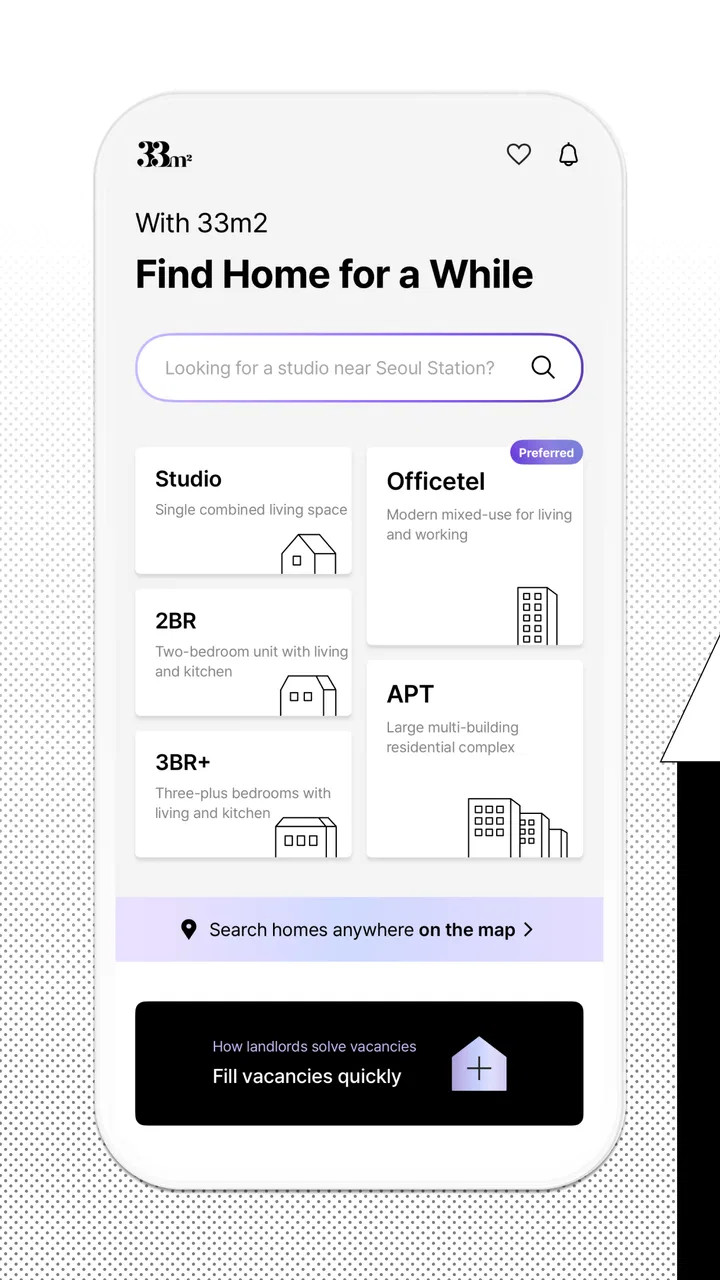
Finding a temporary place to live in Korea can feel much harder than finding a hotel for a weekend. A hotel is simple to book, but it may not suit someone who needs a more residential setup, extra time, or a location that works for study, work, or a move between cities. That is where 33m2 caught my attention. It is a free House & Home app from SPACEV focused on short-term homes in Korea, including studios, officetels, and apartments.
I approached it as a practical decision rather than a simple app test: would it help someone narrow down a temporary home without making the search more confusing? My answer is mostly yes, especially if your priority is browsing Korean rental options in one focused place. It is not a universal replacement for every housing route, though. The usefulness depends heavily on how well the available listings match your dates, preferred area, budget, and comfort with arranging a stay in Korea.
The app is aimed at Everyone, costs nothing to install, and supports devices running Android 8.0 or later. It has reached over a million installs and holds a 4.7 average from around 5.1 thousand ratings, which suggests that many people find the basic experience worthwhile. I still think the better question is not whether it is popular, but whether its short-term housing focus matches the kind of decision you need to make.
You May Also Like

 Blood Strike: 2.5 Anniversary
Blood Strike’s Loadouts Turn Every Drop Into a Tactical Gamble
A close look at Blood Strike’s custom loadouts: how fast access to signature weapons reshapes its battle royale rhythm, rewards preparation, and narrows the gap between fights.

 Pandora - Music & Podcasts
Pandora’s Music Is Easy to Start, but Harder to Recover
Pandora’s strength is its low-effort path from a seed to a station. Its weak spot is how much confidence it asks you to place in connection, setup, and quiet recovery.

 8 Ball Pool
 Is Built on Rivalries, Rematches, and Routine
A close look at the rivalries, rematches, shared routines, and unanswered safety questions that turn a quick pool match into a persistent mobile community.

 Samsung Music
’s Quiet Strength Is Playing What You Already Own
Its reach comes less from spectacle than from dependable access to a personal library. That simplicity is both the app’s strongest retention engine and its ceiling.

 AccuWeather: Weather Radar
AccuWeather Review: A Quick, Clear Forecast for Everyday Decisions
For everyday plans, the best forecast is the one you can understand quickly. AccuWeather makes rain timing, radar, and local conditions easy to act on, with a few trade-offs.

 Hill Climb Racing
Why Hill Climb Racing Still Turns Crashes Into One More Run
A tiny car, a bumpy hill and one more upgrade: Hill Climb Racing keeps resurfacing because its simple chaos makes every near-miss feel personal.
More From Our News Desk
View All News


How I would judge a short-term housing app
When I look for temporary accommodation, I do not start with attractive photos. I first want to know whether the app helps me answer four practical questions: where the property is, whether the rental period fits, what kind of home it is, and how much uncertainty remains before I commit. A polished interface is useful, but it cannot compensate for unclear conditions or a poor match between a listing and the reason I am staying.
That makes 33m2 different from a general hotel-booking service. Its focus on studios, officetels, and apartments points toward a more residential search. I would consider it for a student arriving before a long lease begins, a professional assigned to Korea for a limited period, or someone relocating and needing a temporary base while viewing permanent homes.
I would also judge the app by how quickly it helps me create a shortlist. A good shortlist is not just a collection of attractive homes. It should reflect practical constraints such as access to work or school, the length of the stay, whether the neighborhood feels suitable, and whether the home type fits daily life. The most useful habit is to decide those priorities before opening listings, rather than letting the first appealing photo set the direction of the search.
One detail I appreciate is the distinction between a studio, an officetel, and an apartment. Those labels are not interchangeable in the way a casual traveler might assume. They suggest different living arrangements and expectations, so I would use the property type as an early filter rather than treating every result as the same kind of accommodation.
Building a shortlist instead of browsing endlessly
My preferred workflow would be to begin with the area and stay period, then review only homes that seem plausible for everyday use. After that, I would compare a small group side by side in my own notes. I would record the location, home type, rental conditions, furnishings mentioned in the listing, and any questions that need an answer before booking or contacting the provider.
This is more important with short-term housing than with a one-night hotel. A minor inconvenience becomes a repeated problem when you live somewhere for weeks. A long walk to transport, limited storage, an unsuitable kitchen, or a confusing check-in arrangement can matter more than a stylish interior. The app can support discovery, but I would still treat each listing as the beginning of verification, not the end of it.
A useful non-obvious tip is to search with two plans in mind. First, create a practical shortlist for the exact dates you need. Then create a second shortlist with slightly different neighborhoods or home types. That backup makes the search more resilient if availability changes or a promising property does not work after you ask detailed questions.
Where 33m2 makes the strongest case
The clearest strength is focus. Instead of approaching Korea’s temporary housing market through unrelated categories, I can start with an app built around short-term homes. That reduces the mental jump between “I need somewhere to stay” and “I need a home-like place that fits a temporary period.” For people who do not want to sort through purely tourist-oriented accommodation, that focus is valuable.
I also like the range of home types represented in its purpose. Studios may suit a solo resident who wants a compact private space. Officetels may appeal to someone looking for a city-oriented home that combines residential and work-friendly expectations. Apartments may make more sense for couples, families, or anyone who needs a more conventional layout. The right choice depends on the person, but having those categories in the same search context gives the decision more structure.
For a newcomer to Korea, that structure can be reassuring. A person unfamiliar with local housing terminology may otherwise compare options that appear similar online but serve very different needs. I would not assume that a label answers every question, but it gives me a better starting point for asking the right ones.
A realistic arrival scenario
Imagine arriving in Seoul for a work assignment that lasts long enough for a hotel to become tiring, but not long enough to justify immediately signing a conventional long-term lease. I would use 33m2 to explore studios, officetels, and apartments near the office or a convenient transport route. I would first remove homes that are clearly too far away, then check whether the remaining options appear suitable for daily living rather than merely looking good in photographs.
Before choosing, I would contact the relevant provider with a short list of specific questions: Is the home available for the full period? What exactly is included in the stated rental arrangement? How does arrival work? Are there additional conditions that affect the total commitment? I would keep the answers together with the listing details so I could compare homes without relying on memory.
This workflow shows where the app helps and where my own judgment must take over. It can make discovery more targeted, but it cannot decide whether a particular neighborhood feels right for my commute or whether a listing’s conditions are comfortable for my circumstances. I see that as a sensible boundary for a housing discovery tool.
Useful for relocation, study, and temporary work
The app seems particularly suitable for people in transition. Relocation is one example: I might need a temporary home while learning a new area and arranging a longer-term move. A student could use it while settling into Korea before deciding whether to share, rent long term, or move closer to campus. A remote worker or project-based employee could value a residential option that feels more settled than a hotel.
It may also help someone supporting a family member from another country. In that situation, the search is not just about finding a bed. It is about reducing uncertainty around the neighborhood, home type, and length of stay. I would still want the future resident to inspect the final details personally or through a trusted contact, but the app can make the first stage less scattered.
Another practical insight is to use the app before the trip, not only after landing. Early browsing can reveal which neighborhoods and home types repeatedly fit your needs. That gives you time to adjust expectations, prepare questions, and identify backup areas. Waiting until the last moment turns every imperfect listing into an emergency decision.
What the public signals suggest, and what they do not replace
The app’s 4.7 average and more than a million installs give me confidence that it has found a real audience. The current version is 3.4.40, and the app has been available since December 12, 2019, so it is not a brand-new experiment. Those details matter because housing searches benefit from a service that has had time to develop beyond its first release.
Still, a strong overall rating cannot tell me whether every listing is suitable for my particular dates or neighborhood. Ratings describe the broad app experience, while housing decisions are highly personal. I would use the rating as a reason to try the app, not as a reason to skip careful checks on an individual property.
Where other approaches may fit better
33m2 is not automatically the best choice for every accommodation search. If I only need a hotel for a few nights, a conventional hotel platform may be faster because its entire process is designed around short stays, room availability, and familiar booking expectations. In that case, the residential focus of this app may add a step rather than remove one.
It may also be less suitable for someone seeking a traditional long-term lease. A dedicated long-term rental route, local agent, or community recommendation may offer a better fit for deposits, contracts, and the legal details associated with a more permanent home. I would not use a short-term housing app as my only source when the real goal is to establish a long-term residence.
Language and local knowledge can also change the balance. Someone comfortable communicating in Korea and checking housing conditions independently may prefer a broader search across several channels. A first-time visitor who needs extensive guidance may prefer a service with more direct support or a trusted relocation specialist. The most convenient option depends on how much responsibility I want to handle myself.
There is another trade-off: a focused inventory can be easier to browse, but it may not show every possible alternative in a city. If my requirements are unusually narrow, such as a very specific neighborhood, a particular accessibility need, or a highly unusual stay period, I would compare 33m2 with other sources rather than assuming its results are exhaustive.
Questions I would resolve before committing
I would not treat a listing photo as proof of the exact living experience. I would confirm the address or precise location, the available dates, the home type, and the conditions attached to the stay. I would also ask about the practical details that affect daily life, such as check-in, furnishings, utilities, internet, cleaning, and what happens if the arrangement changes. These questions are not busywork; they are how I turn a promising search result into a dependable plan.
I would also clarify the payment and cancellation terms before making a commitment. The app is free to download, but that does not mean the accommodation itself is free, and I would never confuse the app’s price with the cost of renting a home. The important financial comparison is the complete stay, including any required charges or conditions explained during the booking process.
For a shared decision, I would send shortlisted properties to the person who will actually live there. A home that looks efficient to me may feel cramped to a couple, while an apartment that suits a family may be unnecessary for one visitor. Getting that feedback early prevents a common mistake: choosing based on the searcher’s preferences instead of the resident’s routine.
The switching cost of using another option
Moving from 33m2 to another housing method is not difficult in a technical sense, but it can cost time and attention. I would need to rebuild my shortlist, learn a different set of property labels, repeat questions, and possibly compare information presented in different formats. That effort is worthwhile when another option offers a clearly better match, but it is not worth switching simply because another service has a larger general accommodation catalog.
The opposite is also true. If I begin with a broad hotel or rental platform and realize that I need a home-like short-term stay in Korea, switching into a focused service may save time. The key is to switch based on the type of decision, not on habit. I would choose the tool that matches the stay: tourist room for a brief visit, short-term home for a transitional period, or a long-term rental channel for permanent plans.
A practical way to reduce switching costs is to keep a simple comparison note outside the app. I would copy only the information needed to decide: location, dates, home type, total conditions, unanswered questions, and next action. That prevents me from becoming dependent on one interface and makes it easier to compare a 33m2 result with an alternative without losing track of the details.
Who should skip it
I would skip 33m2 if I were taking a very short trip and wanted the quickest possible hotel reservation. I would also look elsewhere if I needed a highly specialized long-term contract or if I already had a trusted local agent who could handle the search and verification more directly.
I would be cautious about relying on it alone if I could not communicate with providers, evaluate neighborhoods, or verify the final terms. The app may narrow the search, but short-term housing still involves real-world decisions that are difficult to make from a screen. Anyone expecting a completely hands-off process may find the remaining questions frustrating.
It is also not the right fit for someone who wants to browse every accommodation category in one place. Its strength comes from concentrating on studios, officetels, and apartments in Korea. If that concentration does not match the stay, a broader travel service may feel more efficient.
My recommendation after weighing the trade-offs
I recommend 33m2 to people who need a temporary, home-like place in Korea and want to begin with a focused search rather than a general hotel catalog. I especially see value for newcomers, students, temporary workers, relocating households, and anyone who needs time to settle before making a longer-term housing decision.
I would use it as the first layer of the process: discover suitable homes, understand the available categories, build a shortlist, and identify the questions that need answers. I would not use it as the only layer. Before committing, I would verify the stay period, location, conditions, and practical details directly through the relevant rental process.
SPACEV has made a free app with a clear purpose, and the established release history, current version 3.4.40, and strong user response make it easy for me to recommend trying. The app’s real advantage is not that it removes every difficulty from renting. It gives a person looking for a short-term home in Korea a more relevant starting point than a generic accommodation search.
My final advice is simple: download it when your need is a temporary Korean home, not merely a place to sleep. Start with your dates and daily routine, compare studios, officetels, and apartments according to how you will actually live, and keep a backup shortlist. Use 33m2 to narrow the decision, then use careful questions to make the final one.
FAQs for 33m2 - Korea Short-Term Rental
01What is 33m2 - Korea Short-Term Rental?
33m2 - Korea Short-Term Rental is an app designed to help travelers and locals find short-term rental accommodations in Korea. It offers a variety of options ranging from budget-friendly to luxurious stays, providing users with comprehensive details about each property, including amenities, pricing, and location, to ensure a comfortable visit.
02How does the booking process work on the app?
To book a rental, users can browse listings, filter results based on their preferences, and select a property. Once a choice is made, users can view detailed information, check availability, and proceed with booking directly through the app. Secure payment options are provided to ensure a smooth and safe transaction.
03Are there any additional fees or hidden charges?
The app is designed to be transparent with pricing. However, users should be aware that additional fees such as service charges or cleaning fees may apply, depending on the rental property. These fees are typically disclosed in the listing details, ensuring users are fully informed before confirming their reservation.
04Is it possible to cancel a booking, and what is the cancellation policy?
Cancellation policies may vary depending on the property owner. Users are encouraged to review the specific cancellation terms outlined in the listing before booking. Most listings provide clear guidelines, including deadlines for free cancellations or any applicable fees for late cancellations, to help users make informed decisions.
05What safety measures are in place for users?
33m2 - Korea Short-Term Rental prioritizes user safety by verifying listings and providing user reviews and ratings. Additionally, the app offers secure payment methods to protect financial information. Users are also encouraged to communicate with hosts through the app’s messaging system for additional security and support.
Pros
- User-friendly interface for easy navigation.
- Wide selection of rental properties available.
- Detailed property descriptions and images.
- Secure booking and payment process.
- Responsive customer support team.
Cons
- Limited language options for app interface.
- Occasional bugs during booking process.
- Not all listings have reviews yet.
- Some properties lack detailed amenities info.
- Requires stable internet for optimal use.

33m2 - Korea Short-Term Rental
Gallery